Travel comfort • Materials • Sleep
Travel Pillow Design: Balancing Neck Support, Packability, and Fabric
A useful travel pillow has to solve several problems at once: support the head when a seat offers little, fit into luggage without becoming a burden, and feel comfortable against the face over hours of movement. Shape, filling, cover, and care all matter—and the best balance depends on how and where you travel.
On a long journey, the landscape changes while the body stays still. A train window frames fields and stations; an aircraft cabin hums above the clouds; a passenger leans toward a shoulder, then the aisle, searching for a position that will hold. In these moments, a travel pillow is more than a small cushion. It is a piece of equipment designed for a very particular environment: a seated body, limited space, and rest interrupted by motion.
Start with the journey, not the pillow
There is no single travel pillow that suits every itinerary. A compact neck pillow may be helpful on a long flight, where the head can tilt sideways as sleep deepens. A small rectangular cushion may be more useful on a train, in a car, or at a destination where a familiar surface makes an unfamiliar bed feel more comfortable. For a short commute, a bulky or structured design may be more gear than the journey requires.
Before comparing materials, consider the conditions in which the pillow will be used. How long will you be seated? Will you have room to attach a pillow to a bag, or must it fit inside a carry-on? Do you tend to fall asleep upright, or do you prefer to rest against a wall or window? Will the pillow be used only occasionally, or carried on frequent trips where washing and drying become part of the routine?
These practical questions help clarify what “comfortable” means. Some travelers want a pillow that limits side-to-side movement. Others want a soft, low-profile cushion to place behind the head or lower back. A well-designed travel pillow cannot correct every seat, posture, or sleep challenge, but it can make it easier to find and maintain a tolerable resting position.
Neck support begins with shape
Contoured neck pillows are designed to sit around the neck and provide a surface for the head to lean against. Many have a curved or horseshoe-like outline, though details vary: some rise higher at the sides, some are more compact at the back, and some close at the front with a clasp. The idea is simple—reduce the distance the head can fall when the muscles relax.
Fit matters more than appearance. A pillow that is too tall can push the head forward, while one that is too low may offer little resistance when the head tips sideways. A traveler’s neck length, shoulder width, preferred posture, and seat geometry all influence the result. A closure can help keep a pillow in place, but it should not feel tight or force the chin into an uncomfortable position.
Try to assess where the pillow will make contact. Does the shape support the sides of the head, the back of the neck, or both? Can you turn your head comfortably? Does the pillow stay in place when you shift? These are more useful questions than whether a design looks plush on a shelf. The goal is gentle support, not immobilization.
Travel pillows are not medical devices, and claims about posture or pain relief should be treated cautiously. If a person has persistent neck pain, numbness, or another ongoing concern, a travel cushion is not a substitute for advice from a qualified health professional. For ordinary travel comfort, a supportive shape can still be valuable, especially when the head tends to drop during brief periods of sleep.
Structured foam and softer fills
Filling gives a pillow its character. Memory foam is often used in contoured neck designs because it compresses under pressure and slowly returns toward its original form. That yielding response can help the pillow conform to the neck and head rather than feeling uniformly springy. The degree of firmness, density, and thickness varies, however, so “memory foam” alone does not tell you how a pillow will feel.
Foam can provide a more defined shape than a loosely filled cushion, but structure has a trade-off: it may take up more space and can feel warm to some travelers. A removable cover helps with cleaning, but the foam core itself may have separate care limits. Check the label before washing any component; soaking or machine-washing foam may damage its structure or make it difficult to dry fully.
Other travel cushions use fiber, down-like fill, or blends. These may feel softer and more compressible, sometimes making them easier to pack or use as a general-purpose cushion. The feel can be less consistent if the fill shifts or clumps, and a very soft pillow may not provide enough resistance for someone who needs a stable surface around the neck. Design and construction determine how well a particular fill works.
Some designs combine materials to balance surface softness with internal support. The outer fabric may feel cool and smooth while a denser core carries much of the load. In a travel neck pillow made with memory foam, for example, the fabric contributes to comfort against the skin, but it is the shape and core that establish the pillow’s overall structure. Consider those layers separately rather than assuming one material does everything.
Packability is about the whole object
A pillow’s dimensions are only one part of its portability. Weight, compression, closure, attachment options, and the shape of the packed item all affect whether it earns a place in a small bag. A pillow that compresses easily may be convenient to stow, but repeated compression can affect some fills. A firm contoured design may keep its shape well while taking up a fixed amount of space.
Think about where the pillow will ride between uses. A clip or strap can attach a neck pillow to the outside of a bag, freeing interior room, though an exposed pillow may collect dust or be awkward in crowded spaces. A drawstring bag can keep a cushion together with other travel essentials. If the pillow must fit inside a cabin bag, compare its packed dimensions—not only its size when in use—with the space you realistically have available.
Small rectangular travel pillows can be versatile. They can support the head while reclining, provide cushioning behind the back, or offer a soft surface at a destination. But that versatility may come at the expense of the shaped support offered by a neck-specific design. Consider the pillow’s main job: a cushion used in several positions is a different tool from one intended to steady the head in a seated posture.
It is also worth thinking about the rhythm of a trip. A pillow used on a single overnight flight may not need the same packability as one carried daily between trains, hotels, and workspaces. Frequent travelers often benefit from a design that is easy to attach, refresh, and repack without a complicated routine.
The cover: the surface you actually feel
The cover is the layer in contact with the face, hair, and neck. Its texture, breathability, and ease of cleaning can shape the experience as much as the filling does. Smooth fabrics may feel pleasant against the skin, while textured or warmer fabrics can feel less comfortable in a heated cabin. A cover that can be removed is particularly useful when a pillow is used repeatedly between laundry days.
Silk is one option for a travel pillow shell. Its smooth surface can reduce the sense of drag against hair and skin compared with a rougher textile, and it offers a cool, soft hand for many sleepers. These qualities are not a promise of cosmetic results, nor do they make the pillow itself more supportive. The neck’s comfort still depends chiefly on fit, shape, and filling.
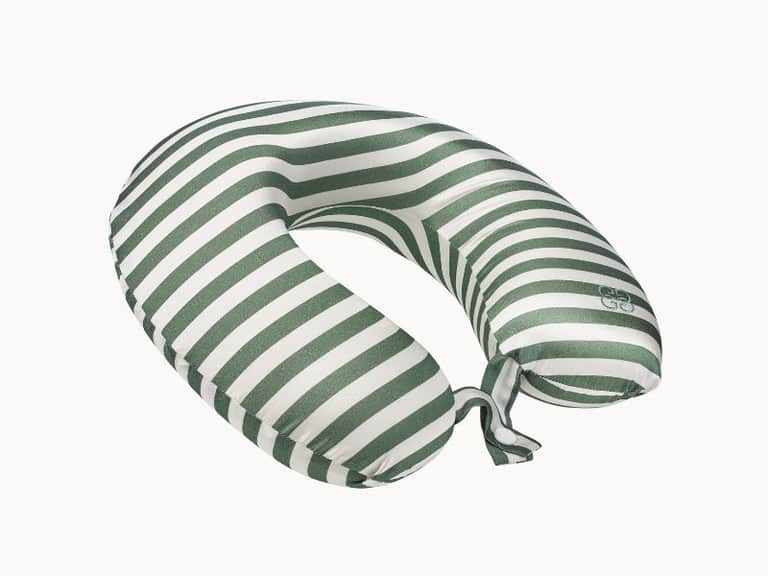
A product example is the New Silk Travel Neck Pillow in Green & Ivory Stripe, which pairs a contoured profile and memory-foam cushion with a 100% mulberry silk shell. Its listed dimensions are 12 by 12 by 4 inches; it also has a clip closure and removable cover. Those details make it possible to assess the design against a traveler’s needs without assuming that one construction suits everyone.
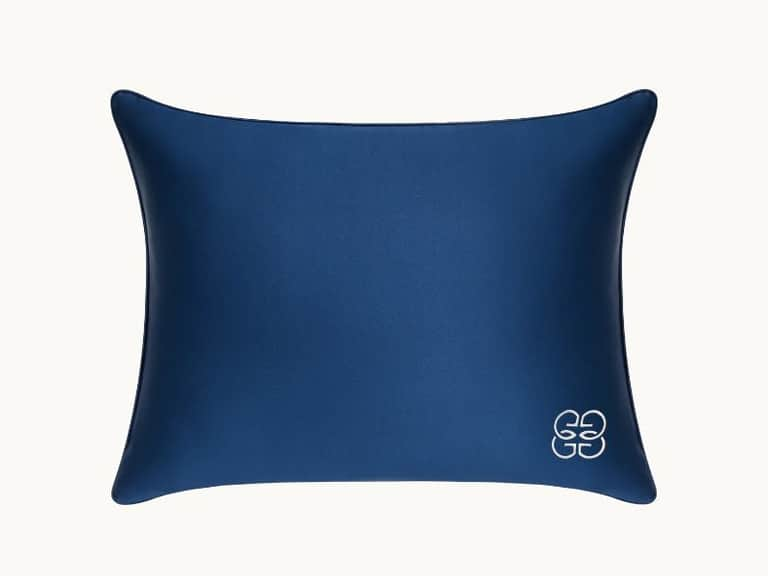
For those who prefer a compact cushion rather than a neck-contoured shape, the Silk Travel Pillow in Navy has a 19-momme mulberry silk exterior and a cushion filling made from long-strand mulberry silk wrapped around a polyester core. Its casing is cotton sateen. This layered construction illustrates why it helps to read the complete material description: a pillow’s shell, inner casing, and fill may each use different fibers and serve different purposes.
Silk is not the only reasonable choice. Cotton, polyester blends, and other fabrics may be more familiar, easier to care for, or better suited to a particular budget. The useful question is not whether one fabric is universally superior, but whether the surface feels comfortable and whether its maintenance fits the way the pillow will be used.
Removable covers and the realities of travel
Travel can expose bedding to more than ordinary household use: a pillow may move from a plane cabin to a car, a station, a hotel, and a packed bag. A removable cover creates a practical boundary between the part that touches the traveler and the inner cushion. It can be washed separately, provided the care label permits it, and may be easier to air out or replace than a pillow with an integrated cover.
Check how the cover comes off and goes back on. A zipper can make removal straightforward, but its placement should not create a hard edge against the face or neck. An envelope closure avoids a zipper but may be less convenient on a tightly fitted cover. A clip or closure at the front of a neck pillow can help keep the shape in place, though the hardware should not press against the throat or interfere with movement.
Care instructions deserve attention before purchase, not after the first spill. Some covers can be machine-washed on a delicate cycle; others require hand washing. Silk, in particular, can benefit from gentle handling, cool water, and an appropriate mild detergent. Air drying is often recommended, while high heat can damage delicate fibers. Always follow the specific label, because construction and finishes differ from one pillow to another.
Do not assume that a removable cover means the entire pillow is washable. Memory foam and some filled inserts need different treatment. Spot cleaning may be the only suitable option for the core, and thorough drying is important before the pillow is stored. A damp cushion sealed inside luggage can develop an unpleasant odor and may be harder to refresh.
A practical comparison before you choose
It can help to compare travel pillows by the job they are expected to do rather than by a single feature. A structured neck pillow may make sense for long stretches in an upright seat. A small cushion may suit travelers who want a multipurpose rest surface. A particularly soft, compressible design may be appealing when space is limited, but its level of support should be considered carefully.
- For upright sleeping: Look for a neck-contoured shape that supports the head without pushing it too far forward. Check side height, closure, and fit around your neck.
- For flexible use: Consider a compact cushion that can support the head, back, or arms. Decide whether the versatility is worth giving up some targeted neck support.
- For frequent trips: Prioritize a cover that can be removed and cared for easily, along with a shape that is simple to pack or attach to a bag.
- For sensitive preferences: Pay attention to the surface textile, seams, closures, and any label guidance on washing or drying.
- For limited luggage space: Compare packed dimensions and weight, and consider how the pillow will be carried between uses.
Whenever possible, test the pillow in a seated position similar to the one in which it will be used. A pillow may feel comfortable in a store while standing, yet seem too thick when paired with an airline headrest. If a hands-on trial is not available, pay close attention to measurements, construction details, and return policies.
A note on sleep, posture, and expectations
A travel pillow can make resting more comfortable, but it cannot remove the limitations of sleeping upright. Seats differ in width and recline; cabin temperature, noise, light, and turbulence can interrupt sleep. Even a well-fitted pillow may not prevent stiffness after hours in one position. It is sensible to treat a pillow as one part of a broader comfort plan rather than a guarantee of uninterrupted rest.
When it is safe and practical, changing position, adjusting a seat, and taking movement breaks can help break up long periods of stillness. On journeys where standing is not possible or advisable, small shifts in posture may make a difference. Follow the instructions of the transport operator and avoid forcing the neck into a position that feels strained simply to keep the pillow in place.
Be alert to exaggerated claims. Smooth fabric can alter the feel of contact with hair and skin, and a supportive contour may make a seated nap more comfortable. Neither feature should be interpreted as a medical treatment or a certain route to better sleep. Individual comfort varies, and the right choice is the one that works with the traveler’s body, itinerary, and care habits.
Care that travels well
A simple maintenance routine can keep a travel pillow ready for the next departure. After a trip, remove and wash the cover if its care instructions allow it. Let the insert air out in a dry place, away from direct heat unless the manufacturer specifically recommends another method. Before packing the pillow away, confirm that each part is completely dry.
Keep delicate covers separate from items with zippers, hooks, or rough surfaces that could snag them. A small laundry bag can protect removable fabric during washing and help keep a clean cover apart from used travel items. For spills, blot rather than rub, and consult the care label before applying detergent or stain treatment. Strong chemicals and excess heat can shorten the life of some fabrics and finishes.
Inspect closures and seams from time to time. A loose seam, a damaged clip, or a cover that no longer fits securely can make a pillow less comfortable and harder to keep clean. Small repairs or careful handling may extend useful life, especially for a pillow that accompanies a traveler through many trips.
The best design is the one you will carry
Travel pillows sit at the intersection of engineering and habit. Their curves answer the problem of a head that drifts sideways; their fillings shape how much resistance the neck encounters; their covers determine what rests against the skin. Yet the most refined construction is not useful if the pillow is too bulky to bring along or too demanding to clean after repeated use.
For a long flight or rail journey, a contoured memory foam travel pillow with a removable cover may offer a compelling balance of shape and maintenance. For a traveler who values a more versatile cushion, a compact pillow with a soft textile shell may be the better companion. Silk can add a smooth, breathable surface, while other materials may meet different care, budget, or feel preferences.
Start with the route and the way you rest. Then compare dimensions, shape, filling, cover construction, closures, and washing instructions. The right travel pillow will not make a seat into a bed or silence a cabin, but it can bring a small measure of familiarity to a moving world: a steady place for the head, a comfortable surface, and one less uncertainty between departure and arrival.
Key takeaways
- Choose a travel pillow for the journey and the position in which you expect to rest.
- Compare the neck support provided by the shape, not just the softness of the filling.
- Assess packed size, weight, and carrying options alongside the pillow’s dimensions in use.
- A removable cover can simplify refreshing the pillow, but the insert may have separate care requirements.
- Silk and other smooth textiles affect the feel of the surface; the core construction determines much of the support.
- Follow product-specific care instructions and treat comfort claims as individual rather than guaranteed.